National Bank: enterprise demand fell as profitability rose to 25%
Kazakhstan’s Q3 2026 survey of 3,552 enterprises: a demand index of 48.7, slower price growth and average sales profitability of 25%.

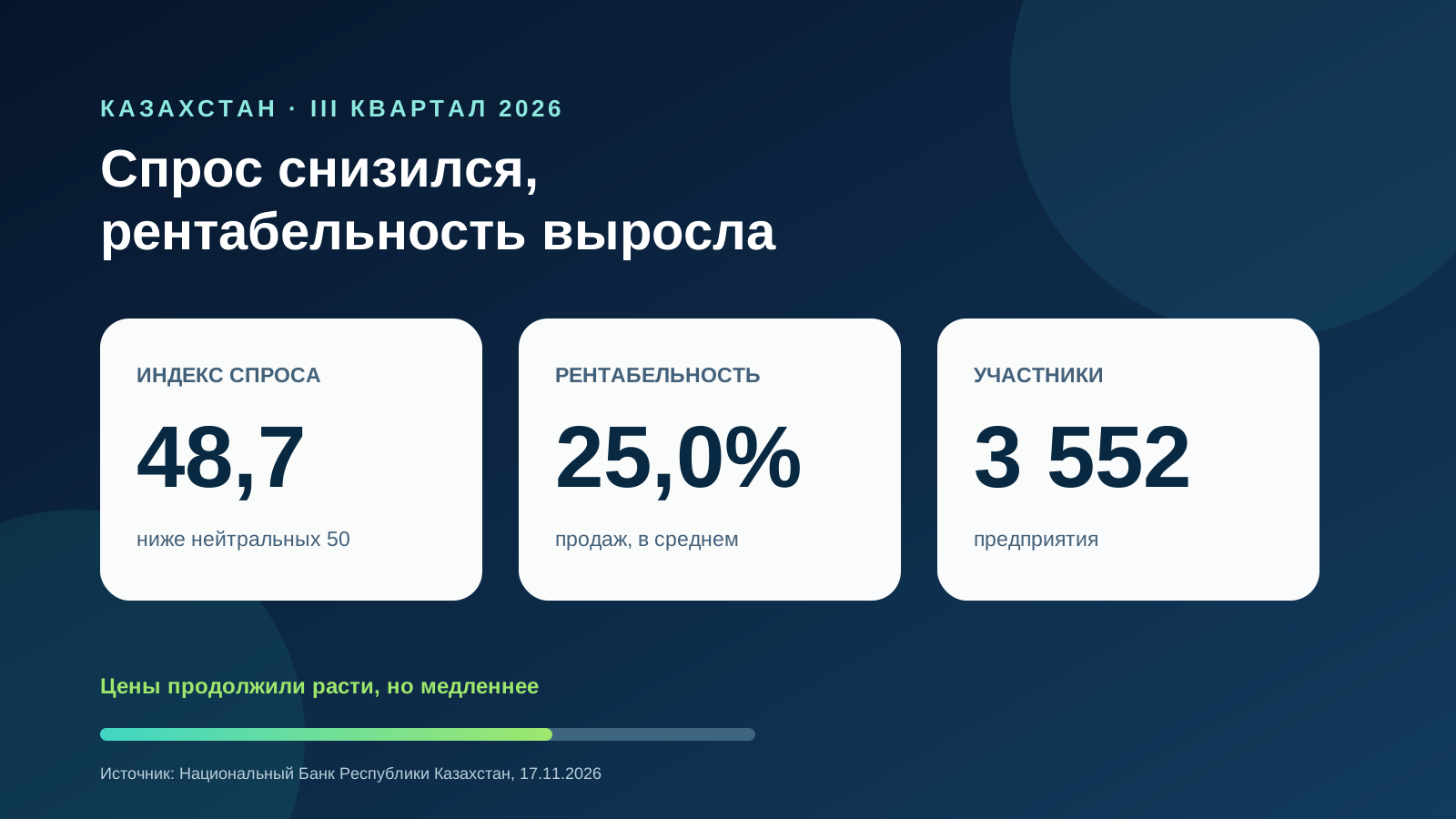
The National Bank of Kazakhstan published its enterprise monitoring results for the third quarter of 2026 on 17 November. The survey covered 3,552 enterprises. Respondents reported weaker demand for finished products, slower price growth and a slight improvement in lending conditions. Average sales profitability nevertheless increased.
This is a business sentiment survey, not the financial statements of every company in Kazakhstan or a forecast for one industry. Its indices describe the direction of change in respondents’ assessments. They should not be read directly as household income, inflation or the profit of an individual business.
Key readings
| Indicator | Q3 2026 | How to read it |
|---|---|---|
| Demand diffusion index | 48.7 | a value below 50 corresponds to weaker demand in respondents’ assessments |
| Finished-product price index | 56.9 | prices continued to rise, but growth slowed |
| Raw-material and input price index | 68.6 | input-price pressure remained pronounced |
| Average sales profitability | 25.0% | up from 24.6% in the previous period |
| Historical average profitability | 22.4% | the benchmark cited by the National Bank |
Profitability is reported before interest, taxes, depreciation and amortisation. It should not be compared directly with net profit or a deposit yield.
Demand weakened
The demand diffusion index was 48.7. In the review’s framework, responses indicating weaker demand outweighed those indicating an increase. The index does not show how many tenge sales declined by, and it does not mean every industry moved in the same direction.
A business can compare this backdrop with its own paid orders, average order value, repeat purchases and returns. If enquiries remain high while completed sales fall, the cause may not be the market alone: assortment, pricing, stock, response time or the offer itself may also matter.
For households, this index is not a measure of purchasing power. The release does not contain household income, spending composition or consumer-confidence data. Any conclusion about family budgets would require separate official evidence.
Prices rose more slowly, but pressure remained
The finished-product price index stood at 56.9, while the raw-material and input price index was 68.6. Both were above 50, meaning respondents more often reported an increase than a decrease. The National Bank nevertheless notes that the pace of price growth slowed.
Enterprises identified input costs as a pricing factor in 76.5% of responses, demand in 75.0%, taxes and fees in 66.6%, and labour costs in 64.6%. Fuel and competitors followed at 55.3% each, the exchange rate at 54.1%, and labour productivity at 50.4%.
These shares describe how widely a factor was mentioned, not its contribution to the final price. The 76.5% figure, for example, is not the share of inputs in production cost. Nor does an index of 56.9 mean consumer prices rose by 56.9%: it is a directional index, not an inflation rate.
Profitability increased despite weaker demand
Average sales profitability before interest, taxes, depreciation and amortisation rose from 24.6% to 25.0%, above the cited historical average of 22.4%. This is not inherently inconsistent with weaker demand. The respondent mix, prices, cost structure and results of larger groups can all affect an average.
The release does not show the full distribution of profitability. An average cannot reveal how many firms made losses or how far sectors differed. A company needs its own income statement, cash-flow data and product-level margins before making operational decisions.
Lending conditions were assessed slightly more favourably
The National Bank reports a small improvement in assessments of both price and non-price lending conditions. This is respondents’ perception, not a promise of an affordable loan. The actual rate, collateral, term and bank decision depend on the borrower and product.
Businesses should separate short-term working-capital needs from long-term investment. Even if lending conditions are seen as somewhat better, debt capacity should be tested against a weaker-demand and higher-cost scenario.
What a company can check now
- Compare sales value, order count and average order value across like-for-like periods.
- Separate revenue growth caused by price from growth in physical volume.
- Identify which inputs and operating costs actually changed.
- Recalculate product-level margin instead of relying on a market average.
- Stress-test liquidity under weaker demand.
- Keep leads and enquiries separate from paid revenue in marketing reports.
The review provides a timely planning backdrop, but it does not replace company data. Pricing, hiring, inventory and financing decisions still need the context of the industry, region and the economics of the individual business.
Sources
- National Bank of Kazakhstan — industry conditions review for Q3 2026, published on 17 November 2026; the full review is attached to the release.

 Leave a review