Kazakhstan tourism services reached KZT 91.2 billion: what the data shows
Kazakhstan's BNS reported 11.4% growth in tourism services in January–June 2026. We explain the scope, resort areas and different visitor measures.

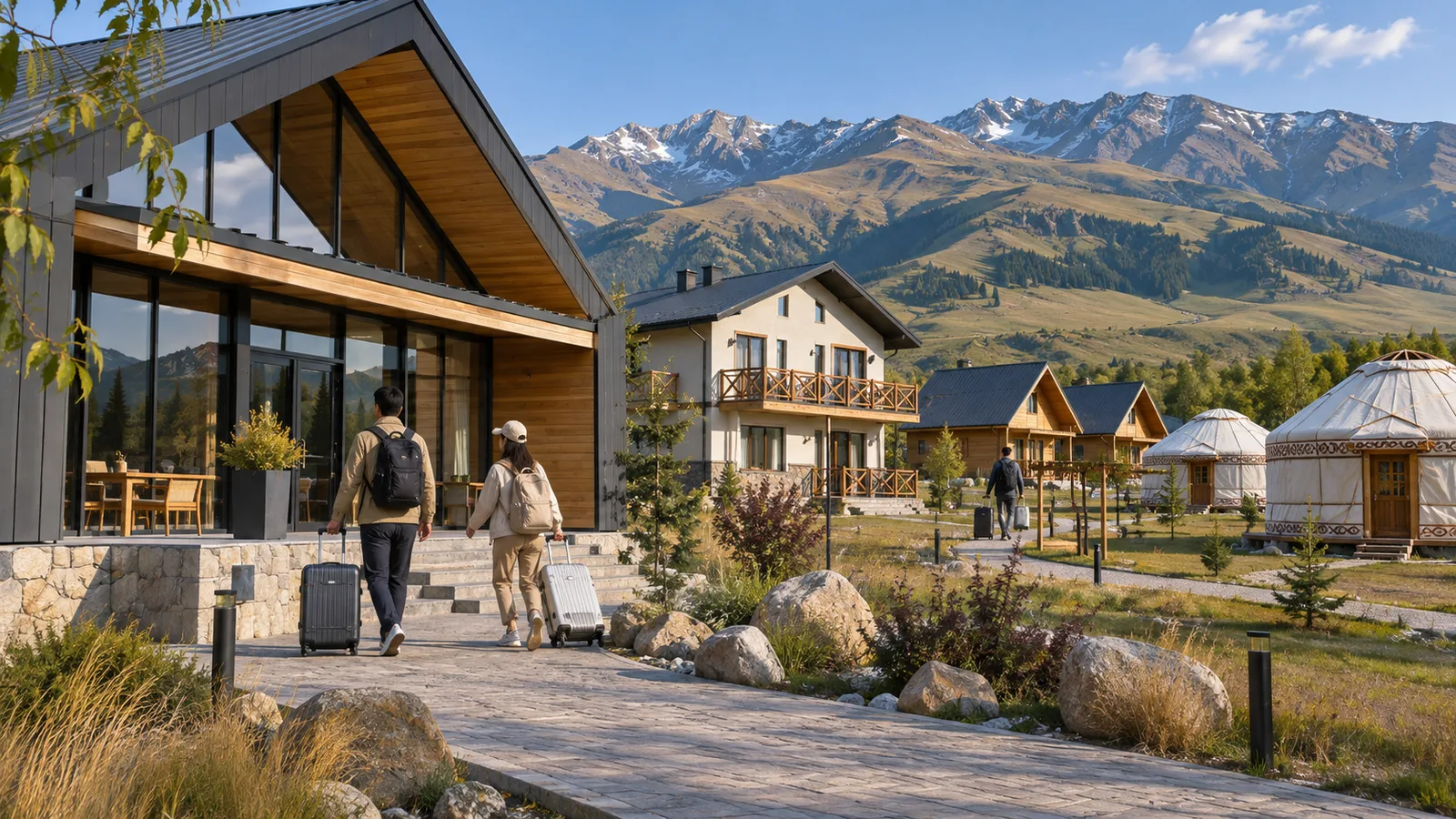
The volume of tourism services in Kazakhstan reached KZT 91.2 billion in the first half of 2026, up from KZT 81.9 billion in the same period of 2025. The Bureau of National Statistics reported an 11.4% year-on-year increase.
The figure matters, but it should not be interpreted as all spending by every traveller in Kazakhstan. It does not prove that visitor numbers rose by the same 11.4% or that every region recorded equal growth. The BNS release dated 20 November describes services and infrastructure in resort areas; the monetary value needs to be read with its scope, accommodation stock, capacity and visitors served.
The monetary value grew faster than capacity
According to the BNS, 1,912 accommodation establishments operated in Kazakhstan’s resort areas. That was 64 establishments, or 3.5%, more than in January–June 2025. Combined one-time capacity increased from 120,200 to 122,400 bed places, while room stock rose from 46,400 to 47,300 rooms.
The monetary value of services therefore grew faster than the number of establishments and available capacity. This does not prove that every hotel or holiday base earned more in real terms. Occupancy, length of stay, extra services, demand mix and price changes can affect the result; the BNS news item does not provide an inflation-adjusted figure.
During January–June, resort-area establishments let 1.58 million rooms and provided 2.79 million bed-days. The average cost of one bed-day was KZT 18,627. This is an aggregate statistical measure, not a universal room rate, package price or family-trip budget.
Activity is highly concentrated
The largest concentration was in the Almaty mountain cluster, with 526 accommodation establishments. The BNS then lists the Alakol resort area in the Jetisu Region with 226 establishments, the Shchuchinsk–Borovoye area with 216 and the Alakol area in the Abai Region with 206.
More than 1.2 million visitors were served in the Almaty mountain cluster during the six months. This represented about 59.4% of visitors to the resort areas covered by the release. Services provided reached KZT 57.1 billion. Such concentration means that one cluster’s performance cannot be applied automatically to the whole country.
Occupancy varied too: 40.1% in the Alakol area of the Abai Region, 39.7% in the Almaty mountain cluster and 37.6% in the Katon-Karagai area. A half-year average smooths out peak weeks, so availability on popular dates may differ substantially.
Domestic tourists and inbound visitors are different measures
Kazakhstan’s Ministry of Tourism and Sports reports that accommodation establishments across the country served 4.77 million visitors in the first half of 2026, including 4.13 million domestic tourists. This nationwide measure covers all accommodation establishments, not only resort areas.
Domestic tourists in this context are Kazakhstan residents who used accommodation services. Inbound tourism concerns non-resident visitors and appears in separate series and surveys. It is not the same as border crossings: not every arrival is a tourist, not every tourist stays in a recorded establishment, and one person may take several trips.
It would therefore be misleading to subtract the rounded 4.13 million from 4.77 million and present the difference as an exact number of foreign tourists. The nationwide 4.77 million should not be compared directly with resort-area visitor counts without explaining their different coverage.
What the data means for travellers
More supply can create additional accommodation options, but it does not guarantee available rooms or uniform price movements in every destination. Travellers should check the specific location, season, accommodation type, what the price includes and cancellation terms rather than treating the national average bed-day as a market rate.
Extra care is useful for destinations with a short high season. A six-month occupancy average hides the busiest periods: spare capacity across the period does not imply availability during the most popular weeks.
What tourism businesses should check
For hotels, holiday bases, tour operators and service companies, the release provides market context rather than a ready-made sales forecast. A practical assessment starts with the business’s own data:
- the share of domestic and international guests;
- occupancy by week and season;
- revenue per sold night and the role of additional services;
- booking source and the cost of a confirmed guest;
- cancellations, repeat enquiries and direct-booking share;
- demand for the specific destination, not Kazakhstan as a whole.
A careful formulation is: “According to the BNS, the volume of tourism services in January–June 2026 increased by 11.4% year on year to KZT 91.2 billion.” Claims such as “tourism grew by 11.4%” or “every traveller spent more” go beyond the evidence published.
Sources
- Bureau of National Statistics — “Tourism services in Kazakhstan increased by 11.4%”, official release dated 20 November 2026.
- Bureau of National Statistics — tourism statistics.
- Ministry of Tourism and Sports — briefing on the development of Kazakhstan's tourism industry, published 4 November 2026.
 Leave a review